
Curious about what social media platforms for healthcare to use? Learn 7 top picks that boost visibility and connect you with patients.
Stethoscopes and waiting rooms aren’t going anywhere, but man, have you seen what doctors are doing online these days? Gone are the sad little pamphlets collecting dust in the corner.
Now your local clinic’s probably got more followers than that guy who posts pictures of his lunch. Different platforms do different things.
Facebook’s where grandma learns about flu shot schedules, Instagram shows off before-and-after physical therapy wins, and LinkedIn?
That’s where the serious medical folks talk shop. Turns out medicine’s not just about healing bodies anymore, it’s about reaching hearts and minds through those little screens we all carry around.
Key Takeaways
- Facebook’s where your mom and her book club friends swap doctor recommendations and share those “I finally beat my arthritis” success stories.
- Instagram and TikTok? That’s for the twenty-somethings who’d rather watch a 30-second video about proper stretching than read a boring handout.
- There’s LinkedIn and Twitter, digital water coolers where docs and nurses keep tabs on the latest medical breakthroughs and spread the word when flu season hits hard.
What Social Media Platforms for Healthcare
Gone are the days when doctors just fixed broken bones and wrote prescriptions in chicken scratch.
Now they’re scrolling feeds between patient visits, tapping through Instagram stories while scarfing down lunch.
There’s Dr. Kim posted about slouching (again) to her 50k TikTok followers, right after sharing job listings on LinkedIn.
And it’s not just her, it seems like every other healthcare provider’s got one hand on the medical chart and the other updating their social status.
Who knew medical school would end up teaching hashtag strategy alongside anatomy?
These docs aren’t just deciding which tests to order anymore, they’re debating if that new health study deserves a tweet thread or a reel.
Strange times in medicine, when your doctor’s social following might be bigger than their patient roster. [1]
1. Facebook for Broad Patient Engagement and Community Building
Your mom’s latest Facebook friend request? Probably from that new medical center downtown. Weird times.
Between Aunt Sarah’s endless garden updates and your cousin’s gym selfies, there’s Dr. Lee dropped some actually decent advice about seasonal allergies.
And people are eating it up, everyone from high school kids to retirees. The real gold’s buried in those Facebook Groups though.
Little digital communities where diabetics swap sugar-free recipes or ex-smokers cheer each other on through day three of nicotine patches.
Usually there’s some nurse keeping an eye on things, but mostly it’s just everyday people sharing what works for them.
Maybe the creepiest part (or coolest, depending how you look at it) is how Facebook knows your daily routine better than your own family does.
That clinic near your favorite coffee spot? They’ll slide right into your feed with a flu shot reminder.
Got knee problems? Watch how fast you start seeing ads for that new joint specialist in town.
It’s like those old neighborhood gossip networks, except now it’s all algorithms and targeted ads.
Pretty sure my phone heard me sneeze yesterday, suddenly I’m seeing allergy med commercials everywhere.
This kind of patient engagement thrives when clinics understand the power of social media for clinics, connecting with patients where they spend their time online.
2. Instagram for Visual Storytelling and Younger Audience Outreach
You know how a photo can say more than a bunch of words? That’s why doctors love Instagram!
They post pictures of smiling patients (who said it was okay) and share tips about feeling better.
Want to peek inside a doctor’s office? Just check their Instagram stories, those quick videos that disappear after a day.
Most kids these days spend tons of time on Instagram. Smart doctors know this, so they make their health advice look super cool with bright colors and fun pictures.
Like, instead of a boring old chart about healthy food, they’ll make a rainbow of fruits that’s actually fun to look at!
Sometimes doctors even make videos to bust those crazy health myths your friends share. You know, like “eating chocolate gives you pimples” (not true!).
They make learning about your body way less boring than those old posters in the school nurse’s office. Who knew health class could actually be fun to watch?
Social media marketing for healthcare can use visual storytelling to enhance patient trust and engagement.
3. LinkedIn for Professional Networking and Brand Building in Healthcare
Credits: Guillaume Moubeche
Imagine a special website where doctors and nurses hang out to talk about work. That’s LinkedIn!
It’s kind of like Facebook, but instead of vacation photos and cat videos, doctors share news about medicine and cool things happening at their office.
When a doctor’s office needs more helpers, they put up a “Help Wanted” sign on LinkedIn. But they do more than just look for new workers.
They also share articles about staying healthy and new ways to fix people up. You know how you trust your science teacher more when they explain things really well? The same thing happens here.
When people see their doctor sharing smart health tips on LinkedIn, they think “Wow, my doctor really knows a lot!” It makes them feel good about choosing that doctor’s office.
4. Twitter for Real-Time Health Updates and Industry Engagement
Doctors love sending quick messages on Twitter. Think of it as passing notes in class, but these notes help keep you healthy!
When bad germs are going around or flu season starts, your doctor can warn everyone super fast.
Twitter only lets you write short stuff, like texting. So doctors write things that are quick and easy to understand:
- “Getting sniffly? Flu shots ready today!”
- “Pollen count high – allergy folks stay in!”
The neat thing is you can write back to them. Got a question? Just ask! They’ll answer where everyone can see it, so others can learn too.
After a while, checking your doctor’s Twitter feels like getting tips from a friend who really knows their stuff. Sort of like having a doctor in your pocket who whispers helpful hints all day.
How to use social media for doctors includes using platforms like Twitter for quick patient updates and building industry engagement effectively.
5. YouTube for Long-Form Educational Content and Patient Trust
Doctors use YouTube like a big video library full of helpful health tips. Instead of quick posts, they can make longer videos that really explain things.
Think of it like having a doctor explain stuff right in your living room! These videos show all kinds of useful things:
- How to take care of diabetes every day
- What happens during a check-up
- Answers to questions lots of people ask
The best part? You can watch these videos as many times as you want. If you didn’t catch something the first time, just hit replay!
Seeing a real doctor talk about health stuff makes it less scary. Plus, whenever you’re worried about something, you can just go back to your favorite clinic’s YouTube channel and find answers.
6. TikTok for Engaging, Bite-Sized Health Education to Younger Demographics
Ever seen your doctor on TikTok? More and more clinics are jumping on this fun app to share quick health tips.
They make silly videos that stick in your head, way better than boring old posters in the waiting room!
These videos might show you:
- The truth about flu shots
- Easy ways to stay healthy
- Cool facts about your body
The best part about TikTok is how fast videos can spread. If a doctor makes a really good one, millions of people might see it!
Kids show these videos to their parents, friends share them with friends, and suddenly everyone’s learning something new about staying healthy.
It’s like passing notes in class, but the whole world can see them. When doctors make these fun videos, more people want to visit their office too.
Makes sense, wouldn’t you rather go to a doctor who knows how to explain things in a way that doesn’t put you to sleep?
7. Complementary and Niche Platforms Supporting Healthcare Communication
Besides the major platforms, clinics also use specialized networks and tools to support their work:
- Google My Business: Clinics manage reviews and share accurate location info to improve local search visibility.
- Blogs: Offer detailed health articles that educate patients in depth.
- Health Forums (e.g., HealthTap, PatientsLikeMe): Spaces where patients and providers discuss health topics and share experiences.
- Professional Communities (e.g., Medscape, Sermo, Doximity): Platforms for healthcare workers to network, learn, and collaborate.
- Wellness Apps (e.g., Fitbit, Headspace): Support patient health journeys with tracking, mindfulness, and fitness guidance.
Using these alongside social media provides clinics with a well-rounded digital presence that covers patient education, professional growth, and community support.
Summary of Social Media Platforms and Their Healthcare Uses
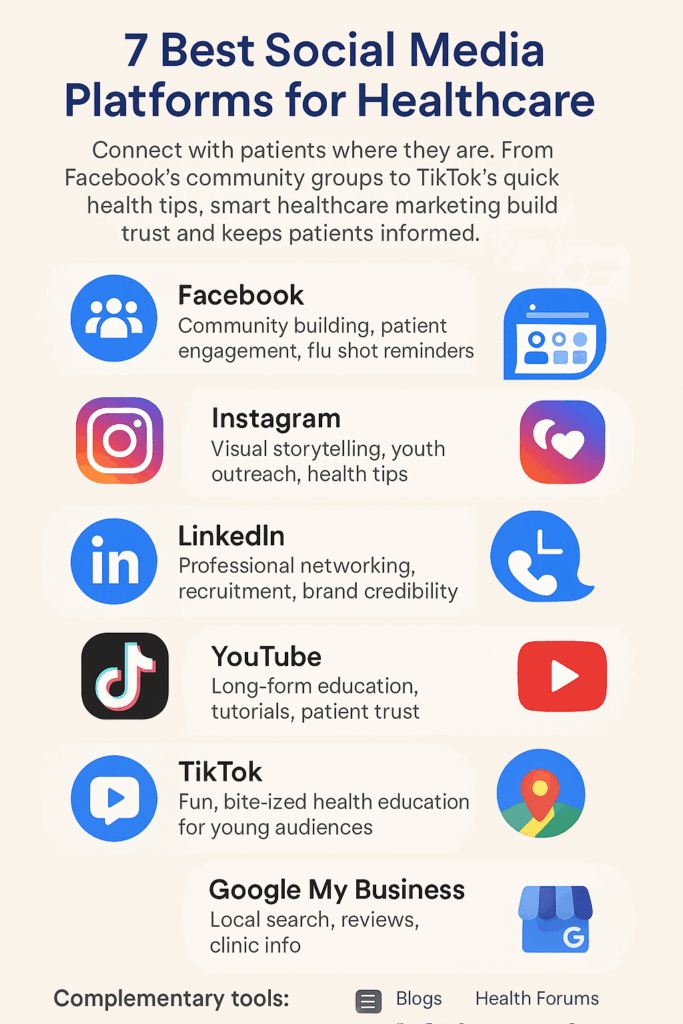
Here’s a quick list of key platforms and how they serve healthcare:
- Facebook: Community building, patient engagement, targeted ads.
- Instagram: Visual storytelling, youth outreach, wellness tips.
- LinkedIn: Professional networking, staff recruitment, brand credibility.
- Twitter: Real-time updates, health alerts, event coverage.
- YouTube: In-depth education, tutorials, patient trust.
- TikTok: Quick, fun health education for younger audiences.
- Google My Business: Local search, reviews, clinic info.
- Blogs: Detailed health content, SEO benefits.
- Health Forums: Patient-provider interaction and support.
- Professional Networks: Medical collaboration and learning.
- Wellness Apps: Patient engagement and health tracking. [2]
Conclusion
Choosing the right social media platforms helps clinics connect with patients in meaningful ways. We at Healing Pixel know that a smart, tailored approach is key.
We help healthcare providers pick and manage platforms that fit their goals and audience, from community building on Facebook to creative education on TikTok.
Explore how Healing Pixel can craft a digital presence that truly delivers results at Healing Pixel.
FAQ
How do doctors use Facebook, Instagram, and Twitter to stay in touch with patients?
Think of Facebook as the town square where everyone meets up, perfect for sharing clinic news and health tips. Instagram’s more like a photo album, showing quick health tips and behind-the-scenes peeks at the clinic.
Twitter? That’s where docs post fast updates like “Flu shots are in!” or “Office closing early due to snow.”
Why do medical folks hang out on LinkedIn and special doctor websites?
It’s like a digital doctors’ lounge. They use LinkedIn to find new staff and share cool stuff their clinic’s doing.
Other special sites let doctors talk shop with each other, kinda like how teachers have their own meetups. It helps them stay sharp and learn what’s new in medicine.
What’s better for learning health stuff, YouTube or TikTok?
YouTube’s great when you want to really understand something, like how to use an inhaler or do physical therapy exercises.
TikTok and Pinterest are more for quick tips, like a 30-second video showing proper hand washing. Both help, just in different ways.
What about those special health websites where patients talk to each other?
These are like online support groups. Some people share what it’s like living with diabetes, others ask questions about new treatments.
Medical students even have their own hangout spots to talk about becoming doctors. It’s nice having a place where everyone gets what you’re going through.
How do health apps help doctors take care of patients?
Apps like MyFitnessPal or Fitbit are like having a health buddy in your pocket. They help you track stuff like exercise and sleep, which makes it easier for your doctor to see how you’re doing.
Plus, these apps often have friendly communities where people cheer each other on, kinda like having workout buddies who never get tired.
References
- https://pmc.ncbi.nlm.nih.gov/articles/PMC10982522/
- https://pubmed.ncbi.nlm.nih.gov/24295109/